

If you’re choosing between a Casio Tough Solar and a Timex Expedition Solar, you’re really choosing between two very different approaches to the solar outdoor watch. Casio emphasizes rugged construction, electronic features, and outdoor functionality, while Timex focuses on the traditional field-watch design found in models such as the Expedition Scout Solar and Expedition North Solar.
I’ve owned the Timex Expedition Scout Solar myself, and I think its simplicity is one of its biggest strengths. It gives you an easy-to-read analog field watch, quartz accuracy, and solar power without loading the watch with features you may never use. Casio takes the opposite approach, offering Tough Solar watches with functions such as alarms, timers, multiple time zones, and, in some models, the rugged construction associated with G-Shock.
So which one is better?
In this Casio Tough Solar vs Timex Expedition comparison, I’ll look at solar technology, accuracy, power reserve, durability, water resistance, legibility, features, outdoor performance, comfort, price, and long-term ownership to determine which watch makes the most sense for different buyers.
Table of Contents
Casio Tough Solar vs Timex Expedition at a Glance
Feature | Casio Tough Solar | Timex Expedition Scout Solar | |
|---|---|---|---|
Power source | Solar | Solar | Solar |
Movement | Quartz solar | Quartz solar | Quartz solar |
Display | Digital, analog-digital, or analog depending on model | Analog | Analog |
Primary focus | Rugged functionality | Affordable field watch | Premium outdoor field watch |
Features | Often extensive | Basic | Model dependent |
Legibility | Excellent, especially digital | Excellent | Excellent |
Outdoor orientation | Strong | Strong | Strong |
Model selection | Very broad | Focused | Focused |
Best for | Feature-focused outdoor buyers | Simple field-watch buyers | Premium field/outdoor buyers |
Main advantage | Functionality and durability | Simplicity and value | More premium execution |
The first thing to understand is that Tough Solar is a technology platform, just as Seiko Solar and Citizen Eco-Drive are. Casio uses the technology across numerous watch families, so there isn’t one single “Casio Tough Solar watch” that represents the entire range.
The Timex Expedition collection is somewhat more focused, although the Scout and North models occupy different positions within it. For this comparison, the most useful question is therefore not which brand has the superior solar technology, but which type of solar watch better fits your needs.
What Is Casio Tough Solar?
Casio Tough Solar is Casio’s solar-powered watch technology. It uses light to generate electrical energy, which is stored and used to power the watch. Casio combines this technology with quartz movements and, depending on the model, a wide range of digital and electronic functions.
That last point is what makes Tough Solar particularly interesting.
A Casio Tough Solar watch can be much more than a simple timekeeper. Depending on the model, you may get features such as alarms, world time, countdown timers, stopwatches, multiple time zones, automatic illumination, and other outdoor-oriented functions.
Some models are also built around Casio’s broader rugged-watch philosophy, including shock resistance and substantial water resistance. The exact capabilities vary considerably between models, so you should always check the specifications of the specific watch you’re considering.
In other words, Tough Solar is particularly well suited to people who see a watch as a piece of equipment rather than simply something that tells time.
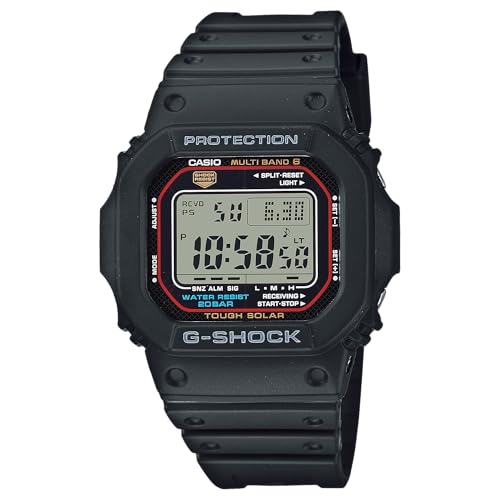
- Tough solar power
- Shock resistant
- Auto light feature will not work if the battery level falls below Medium (marked as M on the face of…
What Is the Timex Expedition Scout Solar?
The Timex Expedition Scout Solar takes almost the opposite approach.
It is a traditional analog field watch with a straightforward dial, familiar numerals, simple hands, and a practical outdoor aesthetic. Solar power is essentially added to an uncomplicated field-watch formula rather than being used as the foundation for a large collection of electronic features.
I’ve owned the Scout Solar myself, and I think its simplicity is one of its strongest characteristics. There is very little to distract you when you look at the dial, and the field-watch layout makes the time easy to read quickly.
That makes the Scout Solar appealing to someone who doesn’t need a watch to function as a miniature outdoor computer. If you primarily want accurate quartz timekeeping, solar power, good legibility, and traditional field-watch styling, the Scout gives you those fundamentals without much complication.
What Is the Timex Expedition North Solar?
The Expedition North Solar represents a more premium interpretation of the Timex outdoor-watch concept. While the Scout emphasizes affordability and straightforward field-watch styling, the North models are aimed at buyers who want a more substantial watch and are willing to spend more for upgraded specifications.
This makes the North particularly relevant when comparing Timex with higher-end Casio Tough Solar models. The Scout competes primarily on simplicity and price, whereas the North gives Timex a stronger answer for buyers who want a more sophisticated outdoor watch while retaining traditional analog styling.
It’s important not to treat all Expedition Solar watches as identical. The Scout and North are designed for somewhat different buyers, just as an inexpensive Casio Tough Solar and a more advanced G-Shock Tough Solar can be dramatically different watches.

- Adjustable brown 20mm Ecco DriTan leather strap fits up to 8-inch wrist circumference; quick-release…
- Charged by any light with a four-month power reserve
- Blue dial with full Arabic numerals & date window at 3 o’clock; 24-hour time; luminant hands
- Silver-tone 41mm stainless steel case with anti-reflective sapphire crystal
- Water-resistant to 100m (330 ft): In general, suitable for snorkeling, as well as swimming, but not…
Tough Solar vs Timex Solar Technology
At the fundamental level, both systems use the same principle: light is converted into electrical energy, stored, and then used to operate the watch.
For the owner, the major advantage is the reduction in routine battery maintenance. Instead of relying on a conventional disposable battery that needs periodic replacement, the watch can replenish its energy through exposure to light.
Casio’s implementation is particularly interesting because it frequently combines solar power with electronic functions that would otherwise place greater demands on the power system. The Tough Solar concept therefore works especially well with Casio’s feature-rich outdoor watches.
Timex takes a simpler approach. The Expedition Scout Solar uses solar power to operate a straightforward quartz field-watch movement, keeping the overall system uncomplicated.
Neither approach is inherently better simply because it is solar. The more important question is what the manufacturer does with that available energy and what the resulting watch offers you.
Which Is More Accurate?
Both Casio Tough Solar and Timex Expedition Solar use quartz-based timekeeping, so both benefit from the accuracy associated with quartz movements.
For most buyers, accuracy isn’t going to be the deciding factor. Both types of watches are designed to provide dependable everyday timekeeping without the regular winding and adjustment associated with mechanical watches.
The exact accuracy specification varies by movement and model, particularly across the very broad Tough Solar lineup. A simple Casio analog model can have different specifications from a feature-rich G-Shock, just as different Timex Expedition models can use different movements.
If your primary requirement is simply accurate, low-maintenance timekeeping, either approach is perfectly reasonable. Casio’s advantage comes from everything it can add around that basic quartz timekeeping rather than from solar technology itself.
Power Reserve and Storage
A solar watch doesn’t stop as soon as it is removed from a light source. The electrical energy generated by the solar cell is stored internally, allowing the watch to continue running when it is temporarily away from light.
The exact reserve depends on the movement and model, so this is another specification that needs to be evaluated individually. Tough Solar watches with numerous electronic functions may have different power requirements from a simple analog solar watch.
The practical lesson is the same for both brands: regular exposure to light is the best way to keep a solar watch ready for use.
If you wear the watch regularly, it will naturally encounter light throughout the day. If you rotate it with several other watches and leave it in a dark drawer for months, it may eventually require additional light exposure before you return it to normal service.
How Well Do They Charge Indoors?
Solar watches can generate energy from indoor light as well as sunlight, although charging efficiency varies significantly depending on the light source and intensity.
Natural daylight is generally much more effective than weak indoor lighting, which means a watch that regularly sees daylight has an easier time maintaining its stored energy. This applies to both Tough Solar and Timex Solar watches.
The important thing is that you don’t need to treat the watch like a rechargeable electronic device that must be plugged in every few days. Normal wear and exposure to light are generally part of the operating cycle.
A solar watch that spends most of its life in darkness is a different matter. If you’re storing one for a long period, it’s worth consulting the manufacturer’s instructions for the recommended storage and charging procedure.
Which Is More Durable?
This is one category where Casio Tough Solar generally has the advantage, although the specific Casio model matters enormously.
Casio has built much of its reputation around rugged watches, particularly within the G-Shock family. Many Tough Solar models combine solar power with shock resistance, substantial cases, and outdoor-oriented features.
That doesn’t mean every Tough Solar watch is automatically tougher than every Expedition Solar watch. Casio makes many different watches, and Timex also produces Expedition models designed for outdoor use.
The difference is that ruggedness is a central part of Casio’s identity, particularly with G-Shock. If your idea of an outdoor watch involves exposure to hard impacts, demanding activities, or a large amount of electronic functionality, Casio has a very strong advantage.
Water Resistance
Water resistance is another area where you need to compare specific models rather than brands.
Casio offers Tough Solar watches with a wide range of water-resistance specifications. Some are designed for ordinary everyday exposure to water, while others are built for much more demanding conditions.
Timex likewise offers different water-resistance ratings across its Expedition collection.
If you regularly swim, snorkel, kayak, hike in wet conditions, or work around water, don’t assume that any solar watch is automatically suitable. Check the exact water-resistance rating and follow the manufacturer’s guidance for crowns, buttons, and water exposure.
For ordinary everyday use, many models from both brands provide sufficient water resistance. For genuinely demanding water activities, however, a purpose-designed Casio model may offer a more compelling combination of features and construction.
Legibility: Timex Keeps It Simple
The Expedition Scout Solar has a significant advantage if your definition of legibility is simply “look at the dial and instantly know the time.”
Its traditional field-watch layout is clean and familiar. Large numerals, straightforward hands, and limited dial clutter make it easy to read without interpreting additional information.
Casio can provide excellent legibility as well, particularly with digital displays. A good digital Tough Solar watch can actually be easier to read than an analog watch in many situations because the numbers are displayed directly.
The difference is that Casio frequently gives you much more information to process. Depending on the model, you may be looking at the time, date, day, world-time setting, battery indicator, and other information simultaneously.
If you want maximum information, Casio is attractive. If you want minimum visual complexity, the Expedition Scout has the advantage.
Features: Casio Wins Easily
This is probably the clearest category in the entire comparison.
Casio Tough Solar watches can offer a tremendous range of electronic features. Depending on the model, you can get alarms, multiple time zones, stopwatches, countdown timers, automatic illumination, world time, and other functions.
Some models combine these capabilities with Casio’s rugged construction, creating a watch that is closer to a compact piece of outdoor equipment than a conventional analog timepiece.
The Expedition Scout Solar deliberately doesn’t try to compete on this ground. Its job is primarily to tell you the time, and it does that without surrounding the basic function with a large collection of electronic complications.
If you actually use those extra functions, Casio is the obvious choice. If you don’t need them, the simplicity of the Timex can actually be an advantage.
Analog vs Digital: Which Do You Prefer?
This is an important personal preference that can determine the outcome before you even compare specifications.
Many Casio Tough Solar watches use digital or analog-digital displays, although Casio also produces analog models. The digital format is particularly useful when you want functions such as timers, alarms, or multiple time zones.
The Timex Expedition Scout Solar is much more traditional. Its analog display gives you the familiar experience of reading a conventional field watch, and there is no learning curve involved.
Neither approach is objectively superior.
If you like traditional watches, the Timex will probably feel more natural. If you prefer information density and functionality, Casio’s digital and analog-digital designs are likely to be more useful.
Which Is Better for Outdoor Use?
For demanding outdoor activities, I’d generally give the advantage to Casio Tough Solar, particularly when comparing a rugged G-Shock Tough Solar model with the basic Expedition Scout Solar.
Casio’s combination of solar power, rugged construction, electronic functions, and outdoor features makes it extremely well suited to situations where the watch is being treated as equipment.
The Expedition Scout Solar is better suited to the person who wants an everyday field watch that can accompany them outdoors without needing to be a dedicated survival instrument.
The Expedition North Solar makes the Timex comparison more interesting because it moves the brand toward a more capable and premium outdoor watch. Even so, Casio’s extensive rugged-watch ecosystem gives it the edge if maximum functionality and toughness are the primary requirements.
Which Is More Comfortable?
Comfort depends heavily on the specific model and your wrist, so this is one area where specifications such as case diameter, thickness, weight, lug design, and strap material matter more than brand reputation.
The Expedition Scout Solar has the advantage of being a relatively conventional field watch. Its traditional shape and analog design make it feel familiar on the wrist, particularly if you’re already accustomed to wearing field watches.
Casio Tough Solar watches vary much more. A small analog Tough Solar model can wear like a conventional watch, while a large G-Shock can have a much more substantial presence.
If you prefer a watch that essentially disappears on your wrist, a conventional Timex field watch may be more appealing. If you don’t mind a larger and more substantial watch in exchange for ruggedness and features, Casio offers more choices.
Which Looks Better?
This is entirely subjective, but the design philosophies are very different.
The Expedition Scout Solar has the traditional field-watch look. It is casual, understated, and recognizable as a conventional analog watch. That makes it easy to wear with everyday clothing without drawing much attention to itself.
Casio gives you a much wider visual range, from relatively conservative analog watches to unmistakably rugged G-Shock designs. Some Tough Solar watches look like conventional watches, while others look like technical outdoor instruments.
The best choice depends on whether you want the watch to look like a watch or look like a piece of equipment.
For traditional field-watch aesthetics, I’d choose the Timex. For a technical and rugged appearance, Casio has the stronger lineup.
Price and Value
The Expedition Scout Solar is particularly compelling from a value perspective because it concentrates on a small number of useful features.
You get solar power, quartz accuracy, a highly legible field-watch dial, and an established outdoor-watch design. If those are the characteristics you want, there isn’t much reason to spend significantly more simply to acquire additional functions you won’t use.
Casio’s value proposition is different. You’re often paying for a combination of solar power, durability, electronic functions, and specialized features.
That can make a Tough Solar watch a better value if you actually use those capabilities. A watch with multiple time zones, alarms, timers, illumination, and rugged construction can replace several functions that you might otherwise need separate devices to provide.
The important question is therefore not which watch has more features for the money, but whether you’ll actually use the features you’re paying for.
Long-Term Ownership
Solar quartz watches are attractive for long-term ownership because they reduce one of the most common maintenance requirements associated with conventional quartz watches.
Instead of regularly replacing a disposable battery, the watch replenishes its stored energy through light. That makes both Tough Solar and Expedition Solar appealing to people who want a low-maintenance everyday watch.
Neither technology should be considered completely maintenance-free. Rechargeable energy-storage components can eventually age, and seals, crystals, straps, and other watch components can also require attention over a sufficiently long ownership period.
Casio’s advantage is that many of its rugged watches are designed specifically around demanding use. Timex’s advantage is the simplicity of the Expedition formula, particularly with the Scout.
Casio Tough Solar vs Timex Expedition: Which Should You Buy?
Choose Casio Tough Solar if you want a watch that does more than tell the time. The combination of solar power, quartz accuracy, rugged construction, and electronic features makes Casio particularly attractive for outdoor enthusiasts, travelers, hikers, and anyone who appreciates having useful functions directly on the wrist.
The case for Casio becomes even stronger if you are considering a G-Shock Tough Solar model. G-Shock adds a level of ruggedness and functionality that the basic Expedition Scout Solar simply isn’t intended to match.
Choose the Timex Expedition Scout Solar if you want something much simpler. It is particularly appealing if you prefer a traditional analog field watch and don’t need alarms, timers, multiple time zones, or a large collection of electronic functions.
I’ve owned the Scout Solar myself, and I think its simplicity is exactly what makes it attractive. It doesn’t try to compete with a G-Shock on functionality. Instead, it provides a straightforward field-watch experience with the added convenience of solar power.
Choose the Timex Expedition North Solar if you like the Expedition concept but want something more premium than the Scout. The North gives you a more substantial outdoor-oriented option while retaining the traditional watch character that makes the Expedition family distinctive.
Casio Tough Solar vs Timex Expedition: The Verdict
For rugged outdoor functionality, I’d choose Casio Tough Solar. Casio’s combination of solar power, electronic features, rugged construction, and broad model selection makes it the more capable platform when you want your watch to function as outdoor equipment.
For a simple solar-powered field watch, I’d choose the Timex Expedition Scout Solar. Its appeal is not the number of things it can do, but how well it handles the basic job of being a practical, readable everyday watch.
The Expedition North Solar sits between those two ideas. It provides a more premium Timex outdoor-watch experience for buyers who want something more substantial than the Scout without moving completely into the technical-watch philosophy of Casio.
Category | Winner |
|---|---|
Best overall functionality | Casio Tough Solar |
Best rugged outdoor watch | Casio Tough Solar |
Best traditional field watch | Timex Expedition Scout Solar |
Best simplicity | Timex Expedition Scout Solar |
Best feature selection | Casio Tough Solar |
Best premium Timex option | Timex Expedition North Solar |
Best for digital functions | Casio Tough Solar |
Best for traditional analog styling | Timex Expedition |
The decision ultimately comes down to how you want to use your watch. Casio Tough Solar is the better choice when you want functionality, ruggedness, and features. Timex Expedition is the better choice when you want a traditional field watch that keeps the experience simple.
Frequently Asked Questions
Is Casio Tough Solar better than Timex Solar?
Casio Tough Solar has the advantage if you want rugged construction and additional electronic functions. Timex Expedition Solar is more attractive if you specifically want a traditional analog field watch with solar power and a relatively simple design.
Is the Timex Expedition Scout Solar a good watch?
Yes. The Scout Solar is a particularly good option for someone who wants an affordable, simple solar field watch. Its combination of quartz accuracy, solar power, legibility, and traditional styling makes it well suited to everyday use.
Is Casio Tough Solar reliable?
Casio has extensive experience with solar-powered quartz watches, and Tough Solar is used across a wide range of Casio products. Reliability depends on the specific model and how it is used, but the technology is well established.
Is Casio Tough Solar the same as G-Shock Solar?
Not exactly. Tough Solar refers to Casio’s solar-power technology, while G-Shock is a Casio watch family. Many G-Shock models use Tough Solar, but Tough Solar is also used in other Casio watches.
Which is better for hiking, Casio or Timex?
For demanding hiking and outdoor use, Casio Tough Solar generally has the advantage because many models combine solar power with rugged construction and useful outdoor functions. The Timex Expedition Scout Solar is a good choice if you prefer a simpler traditional field watch for ordinary outdoor activities.
Does Timex make a solar Expedition watch?
Yes. Timex offers solar-powered watches within the Expedition collection, including the Expedition Scout Solar and Expedition North Solar.
Do solar watches need sunlight?
Solar watches can generate energy from different types of light, including indoor light, although stronger light generally produces energy more efficiently. Regular exposure to daylight is particularly useful for maintaining the stored energy in the watch.
Which is better, the Expedition Scout Solar or Expedition North Solar?
The Scout Solar is the better choice if affordability and simplicity are your priorities. The Expedition North Solar is aimed at buyers who want a more premium and substantial outdoor watch and are willing to spend more for it.
Final Recommendation
Choose Casio Tough Solar if you want your watch to function as rugged equipment. Its combination of solar power, quartz accuracy, electronic features, and the availability of highly durable models makes it particularly well suited to people who spend significant time outdoors or simply want a watch that can do more.
Choose the Timex Expedition Scout Solar if you want a traditional field watch and don’t need all those additional functions. Having owned one myself, I think its greatest strength is the simplicity of the package. It gives you an easy-to-read analog watch, solar power, and quartz accuracy without surrounding the basic experience with unnecessary complexity.
Choose the Expedition North Solar if you want a more premium Timex outdoor watch. It offers a middle ground between the Scout’s affordability and Casio’s highly technical approach, making it worth considering when traditional watch design remains important but you want something more substantial.
For me, the decision is straightforward: Casio Tough Solar wins for functionality and ruggedness, while Timex Expedition wins for simplicity and traditional field-watch appeal. Neither is universally better, and that is precisely what makes this a useful comparison for someone deciding what kind of solar watch they actually want.
Ready to Choose One?
Top Brands-
- Citizen Solar Watches — Eco-Drive solar designs with everyday elegance and reliability
- Seiko Solar Watches — Classic analog solar dive and field watches with a strong heritage
- Casio Solar Watches — Rugged and practical watches with proven solar performance
- Garmin Solar Watches — Solar-assisted GPS watches engineered for multisport and endurance
- Timex Solar Watches — Never Stops Ticking – Thanks to the Sun
- Tissot Solar Watches — Where Swiss Craftsmanship Meets Solar Technology
- VAER Solar Watches — American-Assembled Solar Watches Designed to Be Worn Daily
By Use Case-
- Field Watches — Outdoor-focused, low-maintenance watches designed for durability
- Dress Watches — Sophisticated Style That Never Stops
- Dive Watches — Watches with high water resistance and underwater capability
- Military/Tactical Watches — Top-grade toughness that never stops
- Chronograph Watches — Sun-Fueled Chronos: Precision Without Limits


