

I just bought this watch and I must say, are you kidding me? This watch does everything. I don’t think I’m going to ever buy another watch ( Narrator: he will buy many more watches).
The Citizen Promaster Skyhawk A-T is one of the most technically ambitious solar watches we have worn. It combines Citizen Eco-Drive solar power with radio-controlled atomic timekeeping, world time, UTC, a chronograph, perpetual calendar, alarms, countdown timer and a pilot’s slide-rule bezel.
We purchased and have worn the Skyhawk A-T to see how all of that functionality works in everyday use. The result is a fascinating watch that is exceptionally accurate and capable, but also large, complicated and considerably more difficult to master than a conventional three-hand Eco-Drive.
Since we actually own and wear this watch, this review goes beyond the specifications to examine what the Citizen Promaster Skyhawk A-T is really like in everyday use, including its size, comfort, legibility, controls, Eco-Drive performance, atomic timekeeping and overall practicality.
Table of Contents
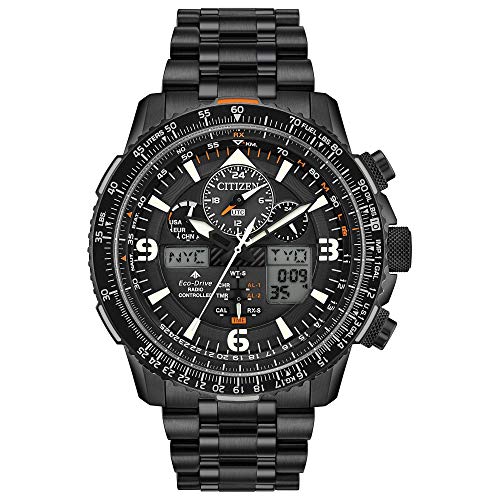
- Modern, pilot-inspired Promaster timepieces equipped for professional use to discover the world from…
- Synchronized to Atomic Time Clock for Superior Accuracy, Atomic Timekeeping Technology with…
- Black Stainless Steel
- Ana-Digi Display; Luminous Hands and Markers; Anti-Reflective Sapphire Crystal
- 200 Meters Water Resistant and 5 Year Limited Warranty
Citizen Promaster Skyhawk A-T Specifications
Specification | Citizen Promaster Skyhawk A-T |
|---|---|
Model | JY8078-01L |
Movement | Citizen Caliber U680 |
Power | Eco-Drive |
Power reserve | Approximately 6 months when fully charged |
Timekeeping | Radio-controlled |
Display | Analog and digital |
World time | 43 cities/regions plus UTC |
Chronograph | 1/100-second, up to 24 hours |
Calendar | Perpetual |
Alarms | 2 |
Countdown timer | Up to 99 minutes |
Crystal | Anti-reflective sapphire |
Case | Stainless steel |
Case diameter | 45 mm |
Lug width | 22 mm |
Water resistance | 200 m |
Strap | Blue leather |
Edition | Blue Angels |
Citizen lists the Skyhawk A-T as a 45 mm stainless-steel Eco-Drive watch with an anti-reflective sapphire crystal, 200-meter water resistance and approximately six months of power reserve when fully charged. The watch uses Citizen’s U680 movement, which combines the solar power system with radio-controlled timekeeping and an extensive range of electronic functions.
Our Experience With the Citizen Promaster Skyhawk A-T
The first thing we noticed after wearing the Skyhawk A-T is that this is not a watch that tries to disappear on the wrist. At 45 mm, it has substantial wrist presence, and the combination of the large case, multiple pushers, rotating slide-rule bezel and complicated dial makes it immediately recognizable as an instrument-style watch. The size initially takes some adjustment, but it also makes more sense once we consider how much Citizen has packed into the case.
The watch has a personality that is very different from a conventional solar three-hand watch. Rather than concentrating on simplicity, Citizen has attempted to provide as much useful information and functionality as possible, and the result feels more like a small electronic instrument than a traditional wristwatch. After spending time with it, we found that this approach is a large part of the Skyhawk’s appeal. People choose this watch for a reason.
The most important distinction between this review and a simple specification overview is that we have actually purchased and worn the watch. That gives us an opportunity to evaluate things such as wrist presence, legibility, controls and everyday practicality that aren’t adequately described by a manufacturer’s specification sheet.
A Watch With an Almost Ridiculous Number of Functions
The Skyhawk A-T has an unusually long list of functions for a conventional wristwatch. Along with basic timekeeping, the U680 provides radio-controlled synchronization, world time, UTC, a perpetual calendar, chronograph, two alarms, countdown timer and various other settings and indications. The pilot’s slide-rule bezel adds another layer of functionality that is unusual even among aviation-oriented watches.
It would be easy to dismiss some of these features as unnecessary, and for many owners they probably are. We don’t need two alarms, a countdown timer, a chronograph and a slide rule simply to tell the time, but that’s not really what the Skyhawk is trying to accomplish. Its appeal comes partly from having an unusually capable collection of tools available on the wrist, even if some of them are used only occasionally.
This makes the Skyhawk particularly interesting for people who enjoy watches as instruments. The watch isn’t merely displaying the time while borrowing aviation styling; its functions are an integral part of its identity.
Eco-Drive Solar Power
The foundation of the Skyhawk A-T is Citizen’s Eco-Drive technology. Instead of relying on a conventional disposable battery, the watch converts light into electrical energy and stores that energy internally, allowing the movement and its electronic functions to operate without routine battery replacement.
Citizen rates the U680 movement for approximately six months of operation when fully charged. That is particularly useful on a watch with this many electronic functions because there is no need to treat the power source as a regular maintenance item.
From an ownership perspective, Eco-Drive is one of the features that makes the Skyhawk so easy to live with. We don’t have to think about periodically opening the case to replace a conventional battery, and normal exposure to light provides the energy required to keep the watch operating. In day to day wearing of the watch (in Canada), I have never seen the charge level drop below fully charged.
The solar system also fits the overall philosophy of the watch extremely well. The Skyhawk is built around electronic functionality, and Eco-Drive provides a practical way of powering that functionality while keeping routine maintenance relatively simple.
Radio-Controlled Atomic Timekeeping
The “A-T” designation is one of the most important parts of the Skyhawk’s identity because it refers to Citizen’s radio-controlled timekeeping technology. Rather than relying solely on the accuracy of its quartz oscillator, the U680 can receive standard time signals and use them to correct the displayed time and date.
When reception is successful, the watch can automatically synchronize itself without requiring manual adjustment. The U680 can also perform a manual reception attempt, while automatic reception can occur during designated overnight periods when radio conditions are generally more favorable.
This is one of the most satisfying features of the Skyhawk because it transforms the watch from simply being a very accurate quartz timepiece into something that can periodically verify its time against an external standard. There is a certain appeal to knowing that the watch has synchronized itself rather than simply assuming that the quartz movement has remained accurate.
Radio-controlled timekeeping does have an important limitation, however. The watch needs to receive a suitable signal, and reception depends on location, conditions and the transmitter being used. The feature should therefore be viewed as an extremely useful synchronization system rather than something that can be assumed to work everywhere and under all conditions. Even though we are located on the east side of North America, it receives a time signal with no issue.
World Time and UTC
The Skyhawk A-T is particularly well suited to people who regularly work with multiple time zones. The U680 provides access to 43 cities or regions plus UTC, allowing the wearer to switch between different locations without manually calculating time differences.
UTC is especially interesting because it has practical applications beyond international travel. Aviation, amateur radio, shortwave broadcasting and many other technical activities use UTC as a common reference, so having UTC available directly on the watch can be genuinely useful.
We also like the fact that the world-time functions complement the radio-controlled timekeeping. The watch isn’t simply maintaining an accurate local time; it provides a framework for keeping track of other time zones as well.
For someone who rarely deals with other time zones, this functionality may be excessive. For travelers, radio enthusiasts (I am a Ham Radio Operator) and people who regularly work internationally, however, it can be considerably more useful.
The Pilot’s Slide-Rule Bezel
The rotating slide-rule bezel is one of the Skyhawk A-T’s defining visual features. It is based on the traditional aviation concept of using a circular slide rule for calculations such as multiplication, division and other flight-related calculations.
Modern pilots obviously have access to far more sophisticated electronic tools, and a wristwatch is unlikely to replace a dedicated flight computer or calculator. Nevertheless, the bezel is functional rather than purely decorative, and it gives the Skyhawk a strong connection to the history of aviation instruments.
For watch enthusiasts, the combination is particularly interesting. The Skyhawk takes a mechanical calculation device that belongs to an earlier generation of aviation equipment and combines it with solar charging, quartz electronics and radio-controlled timekeeping.
That mixture of old and new is one of the reasons the watch has considerably more character than a conventional digital or analog quartz watch.
The Chronograph
The U680 movement includes a 1/100-second chronograph capable of measuring elapsed periods of up to 24 hours. This is an electronic chronograph integrated directly into the movement rather than a traditional mechanical chronograph, which is entirely appropriate given the Skyhawk’s technology-oriented design.
The chronograph is another example of Citizen taking advantage of electronic quartz technology to provide functionality that would be considerably more complicated to implement mechanically. It operates independently of the watch’s primary timekeeping functions and adds another practical timing tool without requiring a separate device.
We wouldn’t suggest that the chronograph alone is a reason to buy the Skyhawk, but it contributes to the overall usefulness of the watch. Like many of its other functions, it is there when needed without adding another piece of equipment to the wrist.
Perpetual Calendar
The perpetual calendar is one of the less conspicuous but more useful features of the Skyhawk A-T. Once correctly configured, the movement automatically accounts for different month lengths and leap years, so the wearer does not have to make routine manual corrections to the date.
This becomes particularly valuable when combined with the radio-controlled timekeeping. The watch can maintain the correct time and date with very little intervention, provided that it is able to synchronize with an appropriate radio signal.
It is a good example of how the Skyhawk’s features work together. None of these individual functions is necessarily revolutionary, but combining them creates a watch that can remain remarkably independent of manual adjustment.
Alarms and Countdown Timer
The Skyhawk includes two alarms and a countdown timer capable of measuring periods of up to 99 minutes. These are functions that many people can live without, but they can be useful for everyday activities when they are available.
The countdown timer is particularly straightforward as a concept. Rather than reaching for a phone to time an activity, the watch can perform the task directly from the wrist, while the two alarms provide another useful option for reminders or scheduled events.
These functions also reinforce the Skyhawk’s identity as a multifunction electronic instrument. Citizen didn’t simply add one headline complication and stop there; the movement is designed to provide a broad collection of practical tools.

The Dial: Brilliant or Overwhelming?
The Skyhawk’s dial is probably its most divisive feature. There is a tremendous amount of information packed into the display, and the first impression can be overwhelming because there are so many scales, indicators, hands and digital displays competing for attention.
After wearing the watch, however, the layout becomes easier to understand. The various elements have specific purposes, and once we become familiar with the different displays, the dial feels less chaotic than it initially appears.
That doesn’t mean the dial becomes simple. It never does, and it isn’t supposed to. The Skyhawk is fundamentally designed around information density, so anyone looking for a minimalist watch should choose something else.
The important distinction is between reading the time and reading all of the information. The primary analog time display is relatively straightforward, while some of the smaller digital information requires more concentration.
Legibility in Everyday Use
The large analog hands make the primary time easy enough to read during normal use, but the smaller displays require more attention. This is an unavoidable consequence of trying to provide world time, UTC, calendar information, chronograph functions and other data without making the watch even larger.
The result is that the Skyhawk works best when we approach it as an instrument rather than expecting every piece of information to be immediately visible at a glance. If we simply want to know the time, the main hands do their job; if we want to examine a secondary function, we need to look more closely.
This is one of the areas where the watch’s impressive feature set comes with a real tradeoff. More information means more visual complexity, and the Skyhawk makes that compromise very clearly.
How Difficult Is the Skyhawk A-T to Use?
The Skyhawk has a definite learning curve, particularly when we first begin using its different functions. The crown and pushers perform different jobs depending on the operating mode, and the movement contains enough functionality that remembering every control combination isn’t necessarily intuitive.
The manual is therefore worth keeping available when first setting up the watch. Once the basic operating system becomes familiar, the controls become considerably easier to manage, but there is no realistic way to describe the Skyhawk as a simple point-and-use watch.
That learning curve hasn’t diminished the appeal of the watch for us. In fact, part of the enjoyment comes from gradually understanding what all of the different controls and displays are doing.
The important thing is to recognize this before buying. Someone who expects the simplicity of a conventional analog quartz watch may find the Skyhawk frustrating, while someone who enjoys complicated electronic watches may consider the learning process part of the attraction.
Wearing the Citizen Promaster Skyhawk A-T
At 45 mm, the Skyhawk A-T is a large watch, and wearing it makes that immediately apparent. It has substantial wrist presence and doesn’t have the discreet character of a smaller field or dress watch, but the size is understandable given the number of displays and controls that Citizen has incorporated.
We found that the watch’s proportions make more sense after spending time with it. The large case provides the physical space required for the dial, digital displays, pushers and rotating bezel, while the overall design reinforces the instrument-watch concept.
Whether the size is a positive or negative will ultimately depend on the wearer. Anyone who prefers compact watches may find it too large, while people who enjoy substantial pilot and tool watches will likely appreciate the presence.
The Skyhawk also isn’t a watch we would choose specifically because we wanted something understated. Its character comes partly from being visually and physically substantial.
Build Quality and Durability
The stainless-steel case, sapphire crystal and 200-meter water resistance give the Skyhawk the specifications we expect from a serious sports-oriented watch. It doesn’t feel like a delicate piece of equipment intended only for occasional wear; instead, its construction supports the instrument-watch personality that Citizen has created.
The sapphire crystal is particularly welcome because the watch is large enough that the crystal occupies a substantial area of the wrist-facing visual package. Sapphire provides considerably greater scratch resistance than conventional mineral crystal, while the anti-reflective treatment helps reduce reflections from the busy dial.
The 200-meter water-resistance rating also gives the case considerable versatility. The supplied leather strap is less appropriate for repeated exposure to water, however, so anyone intending to swim regularly with the watch should consider an appropriate alternative strap.
What We Like About the Citizen Promaster Skyhawk A-T
The first thing that stands out is the technology. The combination of Eco-Drive, radio-controlled timekeeping and a sophisticated multifunction quartz movement makes this much more than an ordinary solar watch.
We also appreciate the accuracy and convenience of the radio-controlled system when reception is available. Having the watch periodically synchronize itself removes one of the routine annoyances associated with conventional quartz watches.
The sapphire crystal and 200-meter water resistance also make the watch considerably more practical as an everyday timepiece. These specifications mean that the impressive electronics are housed in a watch that doesn’t need to be treated like fragile equipment.
Finally, there is the personality of the design. The Skyhawk looks different from most solar watches, and the combination of aviation styling, digital displays and slide-rule bezel gives it a character that is difficult to mistake for anything else.
What We Don’t Like
The biggest drawback is the size. A 45 mm watch is not going to suit everyone, and the Skyhawk’s substantial presence may be too much for people who prefer smaller watches.
The second issue is dial complexity. Although we became more comfortable with it after wearing the watch, there is still a considerable amount of information competing for attention, and some of the smaller displays require a closer look.
The learning curve is another compromise. The U680 is capable of doing a remarkable amount, but that capability means there are more controls and operating modes to understand than on a conventional quartz watch.
Finally, the supplied leather strap doesn’t make the most of the watch’s 200-meter water resistance. The case is capable of handling considerably more water exposure than the strap is likely to enjoy over the long term.
None of these issues makes the Skyhawk a poor watch. They are simply the compromises associated with choosing a large, highly complicated instrument watch.
Citizen Promaster Skyhawk A-T vs. a Conventional Solar Watch
The Skyhawk becomes particularly interesting when compared with a typical solar-powered watch. Most solar watches concentrate primarily on providing reliable quartz timekeeping without requiring regular battery replacement, whereas the Skyhawk adds a substantial electronic feature set on top of the solar power system.
Feature | Skyhawk A-T | Typical Solar Watch |
|---|---|---|
Solar powered | Yes | Usually |
Radio-controlled timekeeping | Yes | Usually no |
World time | Yes | Sometimes |
UTC | Yes | Rare |
Chronograph | Yes | Sometimes |
Perpetual calendar | Yes | Sometimes |
Alarms | 2 | Rare |
Countdown timer | Yes | Rare |
Slide-rule bezel | Yes | Rare |
Sapphire crystal | Yes | Model dependent |
200m water resistance | Yes | Model dependent |
The comparison demonstrates why the Skyhawk occupies such an unusual position. It isn’t simply a solar watch with a few extra features; it is an electronic instrument that happens to use solar power as its energy source.
Who Should Buy the Citizen Promaster Skyhawk A-T?
The Skyhawk makes the most sense for someone who genuinely enjoys technical watches and electronic functionality. Aviation enthusiasts will appreciate the pilot-inspired design and slide-rule bezel, while radio enthusiasts can make particularly good use of the UTC and world-time capabilities.
It is also a compelling choice for anyone who values highly accurate timekeeping but doesn’t want to deal with conventional battery replacement. Frequent travelers may appreciate the world-time functions, while technology enthusiasts may simply enjoy having such a sophisticated movement on the wrist.
The watch is less appropriate for someone who wants a simple everyday watch that can be read instantly and requires almost no interaction. There are much better choices for that purpose, including simpler Citizen Eco-Drive models.
The Skyhawk is for someone who sees the watch’s complexity as part of its appeal rather than as a problem to overcome.
Is the Citizen Promaster Skyhawk A-T Worth Buying?
For the right buyer, we think it is.
The Skyhawk A-T offers a combination of features that is difficult to find elsewhere in a single solar watch. Eco-Drive provides the power system, radio-controlled timekeeping provides exceptional practical accuracy when reception is available, and the U680 movement adds an extensive collection of additional functions.
The important qualification is that the Skyhawk is not universally appealing. Its 45 mm case, complicated dial and learning curve are genuine considerations, and buyers who value simplicity should look elsewhere.
For someone who appreciates technical watches, however, those same characteristics are much less problematic. The watch feels purposeful because Citizen has designed the entire package around functionality.
Citizen Promaster Skyhawk A-T: Final Verdict
After purchasing and wearing the Citizen Promaster Skyhawk A-T, we think its greatest strength is that it has a very clear identity. It isn’t trying to be a minimalist solar watch, a traditional mechanical pilot watch or a piece of understated jewelry; it is a solar-powered electronic instrument with a strong aviation influence.
The combination of Eco-Drive, radio-controlled timekeeping, world time, UTC, chronograph, perpetual calendar, alarms, countdown timer and slide-rule bezel makes it an unusually capable watch. Sapphire crystal and 200-meter water resistance add the durability that makes the technical package practical for everyday wear.
The compromises are equally clear. The watch is large, the dial is busy, some information is small and the controls take time to learn. None of these characteristics is accidental, and someone who buys the Skyhawk should be comfortable with that philosophy before making the purchase.
For us, that is ultimately what makes the Skyhawk A-T interesting. It isn’t simply another solar-powered quartz watch; it is an example of how far Citizen has taken solar technology when the goal is to create a highly capable multifunction instrument.
Our Rating: 4.5/5
Category | Rating |
|---|---|
Solar technology | 5/5 |
Accuracy | 5/5 |
Features | 5/5 |
Build quality | 4.5/5 |
Crystal | 5/5 |
Water resistance | 5/5 |
Legibility | 4/5 |
Ease of use | 3.5/5 |
Wearability | 4/5 |
Overall | 4.5/5 |
Bottom line: The Citizen Promaster Skyhawk A-T is not the solar watch to choose if simplicity is the priority. For someone who wants solar power, exceptional accuracy, extensive functionality and the character of a serious pilot-style instrument, however, it is one of the most interesting watches we have encountered.
Frequently Asked Questions
Is the Citizen Promaster Skyhawk A-T solar powered?
Yes. The Skyhawk A-T uses Citizen Eco-Drive technology, which converts light into energy and stores that energy for use by the watch’s movement. Citizen rates the movement for approximately six months of operation when fully charged.
Does the Citizen Promaster Skyhawk A-T have atomic timekeeping?
Yes. The U680 movement can receive radio-controlled time signals and use them to correct the watch’s time and date. Successful synchronization depends on receiving an appropriate signal under suitable conditions.
Does the Skyhawk A-T display UTC?
Yes. UTC is one of the available time references, which makes the watch particularly useful for people involved in aviation, radio communications and other activities where UTC is commonly used.
How large is the Citizen Promaster Skyhawk A-T?
The case measures approximately 45 mm in diameter, making it a substantial watch with considerable wrist presence. Its size is partly a consequence of the number of displays, controls and functions incorporated into the design.
Does the Skyhawk A-T have sapphire crystal?
Yes. The watch uses anti-reflective sapphire crystal, which provides strong scratch resistance and helps reduce reflections from the dial.
Is the Citizen Promaster Skyhawk A-T waterproof?
The case is rated to 200 meters of water resistance. The supplied leather strap is less appropriate for repeated water exposure, so a different strap would be a sensible choice for regular swimming or other water activities.
Does the Skyhawk A-T have a perpetual calendar?
Yes. The U680 movement incorporates a perpetual calendar that accounts for different month lengths and leap years once the watch has been correctly configured.
Does the Skyhawk A-T have a chronograph?
Yes. Its electronic chronograph measures to 1/100 second and can measure elapsed periods of up to 24 hours.
Is the Citizen Promaster Skyhawk A-T difficult to operate?
There is a learning curve because the watch has many functions and the crown and pushers perform different jobs depending on the operating mode. Once the controls become familiar, the watch becomes considerably easier to use, but it is not designed to be as simple as a conventional three-hand watch.
Is the Citizen Promaster Skyhawk A-T a good everyday watch?
For someone who enjoys large, technical watches, we think it can be an excellent everyday choice. Its Eco-Drive power system, radio-controlled timekeeping, sapphire crystal and 200-meter water resistance make it highly practical, while its size and complicated dial are the main considerations for everyday wear.


